Core Concepts
REAF is built on a layered architecture that promotes modularity, reusability, and a clear separation of concerns. This design separates the high-level logic of a task from the low-level details of hardware or simulation control.
The core of a REAF environment is composed of distinct layers that manage the flow of data from the agent to the robot and back.
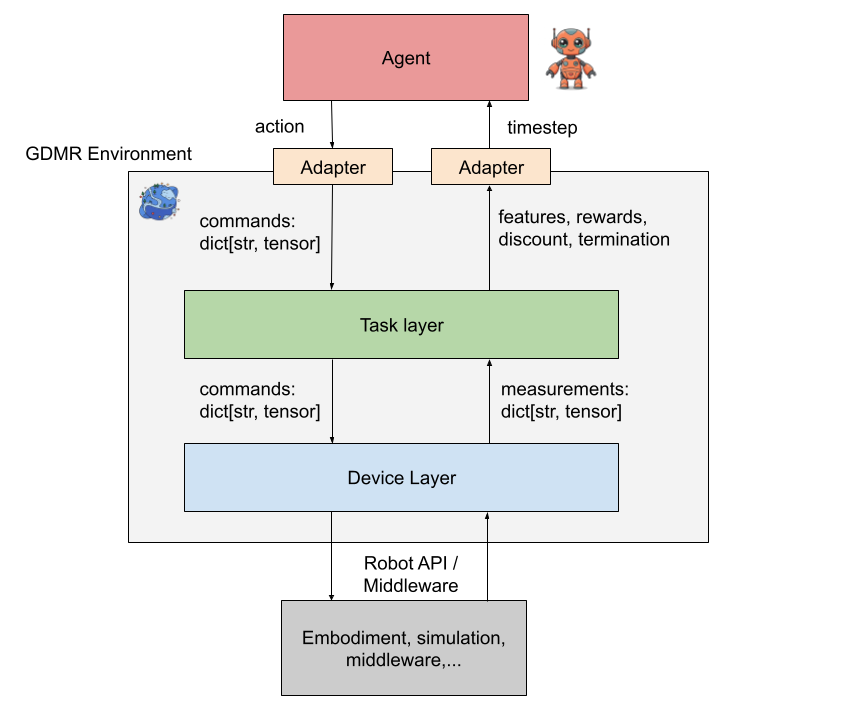
The primary components are:
- Environment: The main entry point that orchestrates the interaction between all other layers.
- Task Layer: Defines the "rules" of the task, such as rewards, terminations, and task-specific features.
- Device Layer: Provides a standardized interface to the robot hardware or simulation.
- Adapters: Translates data between the agent's action/observation space and the environment's internal command/feature space.
- Handlers: Manages custom logic for events like resets and episode endings.
Definitions
Understanding the flow of data in REAF requires a clear distinction between the following key terms. They represent the transformation of data from the agent's intent to the hardware's response and back.
-
Action: The output of the agent's policy. It represents the agent's intent for what it wants to do in the environment (e.g., "move end-effector to position X").
-
Command: A low-level instruction sent to the hardware or simulation, derived from the agent's action. This is the concrete signal sent to the actuators (e.g., "set joint torques to [τ₁, τ₂, ...]"). The conversion from action to command is handled by Action Adapter first and then potentially processed by the Task Layer.
-
Measurement: Raw data received directly from the sensors on the hardware or in the simulation (e.g., raw joint encoder values, raw pixel values from a camera).
-
Feature: A piece of semantically meaningful information derived from raw measurements. Features are computed by the Task Layer to represent the state of the environment in a way that is useful for defining the task (e.g., the Cartesian coordinates of the end-effector, calculated from joint angles).
-
Observation: The data that is actually passed back to the agent. An observation is typically a subset or a transformation of the available features, structured to match the input specification of the agent's policy.
-
TimeStep: A container object that bundles together all the information the environment sends back to the agent after each step. It typically contains the observation, the reward, the discount factor, and the current step type (e.g.,
FIRST,MID,LAST).
Environment
The Environment class is the top-level interface for your robotics
environment, conforming to the
GDM Robotics Environment interface.
It acts as the central coordinator, managing the state and directing the flow of
information between the Task Layer and the Device Layer.
Its key responsibilities include:
reset_with_options(): Resets the environment to an initial state. This involves resetting the Device Layer and computing the first set of features and observations.step(): Advances the environment by one timestep. It takes an agent's action, passes it through the Task Layer and the Device Layer, and returns aTimeStepobject containing the new observation, reward, and status.action_spec()andtimestep_spec(): Define the structure and data types for agent actions and environment timesteps.- Logging: Provides hooks to add and remove loggers for monitoring the environment's internal state.
Adapters
Adapters act as translators between the agent's world and the environment's world. Since an agent may be designed to work with many different environments, its action and observation spaces may not perfectly match the internal commands and features of a specific task.
ActionSpaceAdapter: Converts the agent's actions (e.g., a continuous vector) into a structured command dictionary that the Task Layer can understand.ObservationSpaceAdapter: Transforms the rich feature dictionary from the Task Layer into an observation format (e.g., a flat array or a dictionary of tensors) that the agent expects.
Reset and End-of-Episode Handlers
REAF provides handlers for executing custom logic at critical points in an episode's lifecycle.
EnvironmentReset: Defines the behavior for resetting the environment. REAF gives you complete control over this process, allowing you to implement complex, state-dependent reset procedures tailored to your needs. This can be used, for example, to reset hardware or randomize object positions.EndOfEpisodeHandler: Provides anon_end_of_episode_stepping()callback that is invoked when an episode terminates. This is useful for final logging, analysis, or cleanup operations.
Device Layer
The Device Layer is the component that directly interfaces with the robot's hardware or simulation. Its primary responsibility is to act as a bridge between the abstract, tensor-based world of the REAF environment and the specific APIs of the robotics hardware.
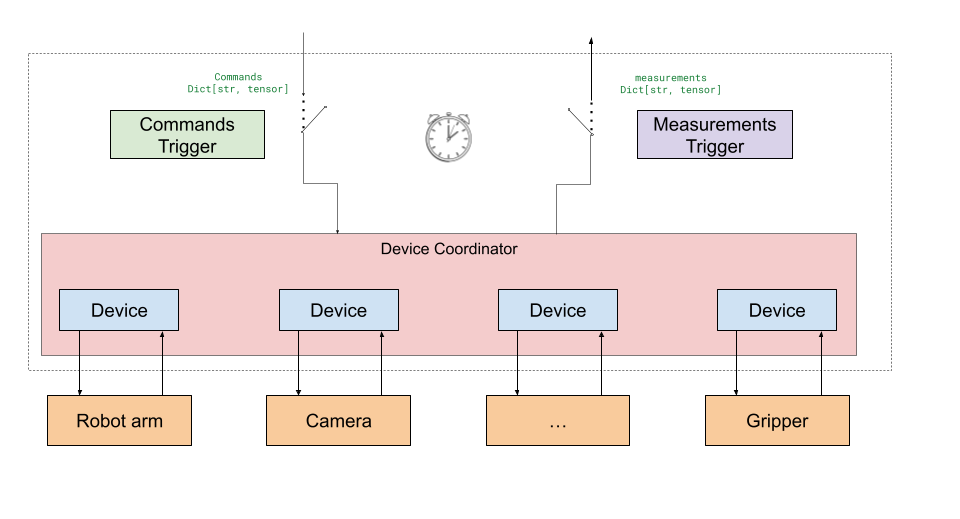
The Device Layer is designed to be a thin and stable layer, focused solely on the task of translating data. It converts NumPy arrays from the Task Layer into low-level commands for the robot and, in the other direction, collects raw sensor data and organizes it into a dictionary of measurements. All task-specific logic, such as calculating rewards or complex features, should be handled by the Task Layer, not the Device Layer. This separation of concerns ensures that the Device Layer is highly reusable across different tasks and experiments.
Core Components of the Device Layer
The Device Layer's design is centered around a few key concepts that promote modularity and reusability:
-
Device: This is the basic building block of the Device Layer. ADevicerepresents a single, self-contained component of the robot, such as an arm, a camera, or a gripper. EachDeviceis responsible for defining its own command and measurement specifications and for implementing the logic to interact with its corresponding hardware. -
DeviceCoordinator: WhileDevices are designed to be independent, aDeviceCoordinatoris used to manage and coordinate a collection ofDevices that make up a complete robotic system. It handles the lifecycle of the devices and provides synchronization points to ensure that commands are sent and measurements are read in a coordinated manner. -
Trigger: ATriggeris an optional component that can be used to control the timing of the Device Layer's operations. For example, a trigger can be used to ensure that the DACL waits for a specific event before reading sensor data, like a new camera frame, or more commonly, to guarantee consistent stepping frequency.
Task Layer
The Task Layer is a core component of REAF that is responsible for defining the logic of a specific robotics task, independent of the underlying hardware. Think of it as defining the rules of the game. It acts as a bridge between the low-level, hardware-specific data from the Device Layer and the high-level, task-specific information required by the agent.
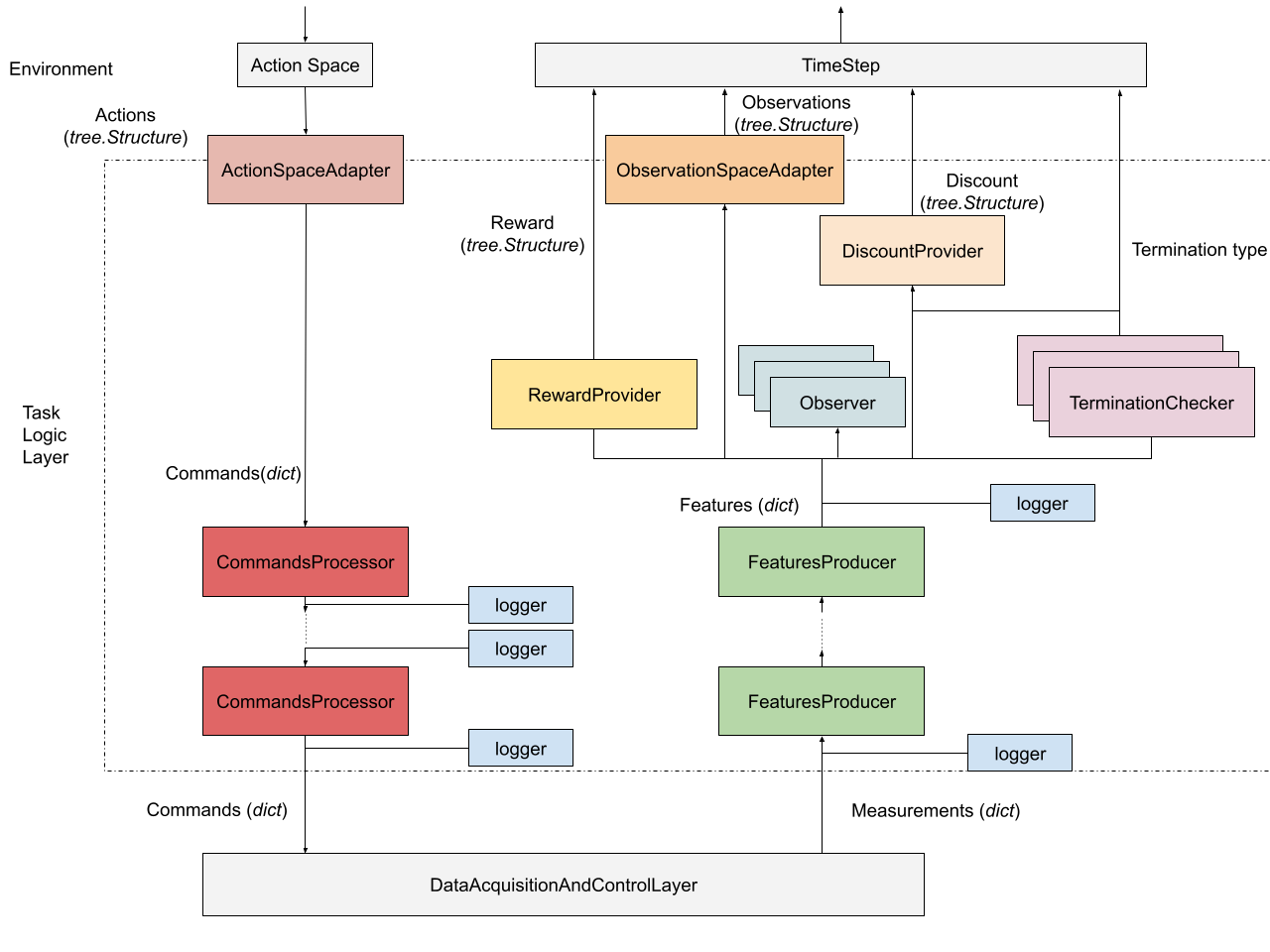
The Task Layer is designed to be highly modular and customizable, allowing researchers to easily adapt a given robotic setup to a wide range of experiments. It is composed of several distinct components, each responsible for a specific part of the data transformation process.
Data Flow in the Task Layer
At each step of the environment, the Task Layer processes data in a sequential flow:
-
Action to Command: The agent's action is first processed by a series of Command Processors, which transform the high-level action into a low-level command that the Device Layer can understand.
-
Measurement to Features: The raw measurements from the Device Layer are then processed by Output Producers, which generate higher-level features that are more meaningful for the task.
-
Reward, Termination, and Discount: These features are then used by the Reward Provider, Termination Checkers, and Discount Provider to compute the reward, check for episode termination, and calculate the discount factor.
Core Components of the Task Layer
The Task Layer is composed of the following key components:
-
CommandProcessor: Modifies the agent's actions before they are sent to the Device Layer. For example, a command processor could be used to convert a 4D Cartesian control action from the agent into a full 6D cartesian command that the robot's cartesian controller expects. -
FeatureProducer: Takes the raw measurement from the Device Layer and generates additional, more abstract features. These producers are immutable, meaning they can only add new features, not modify existing ones. -
RewardProvider: Computes the reward for the current timestep based on the available features. -
TerminationChecker: Determines whether the current episode should terminate or be truncated based on the current state. The Task Layer can have multiple termination checkers, and their results are combined to make a final decision. -
DiscountProvider: Computes the discount factor for the current timestep, which is often dependent on the termination state. -
FeaturesObserver: A passive component that can observe the full set of features without modifying them. This is primarily used for logging and debugging purposes.
Together, these components provide a flexible and powerful framework for defining complex robotics tasks in a structured and reusable way.